Physical Address
304 North Cardinal St.
Dorchester Center, MA 02124
Physical Address
304 North Cardinal St.
Dorchester Center, MA 02124

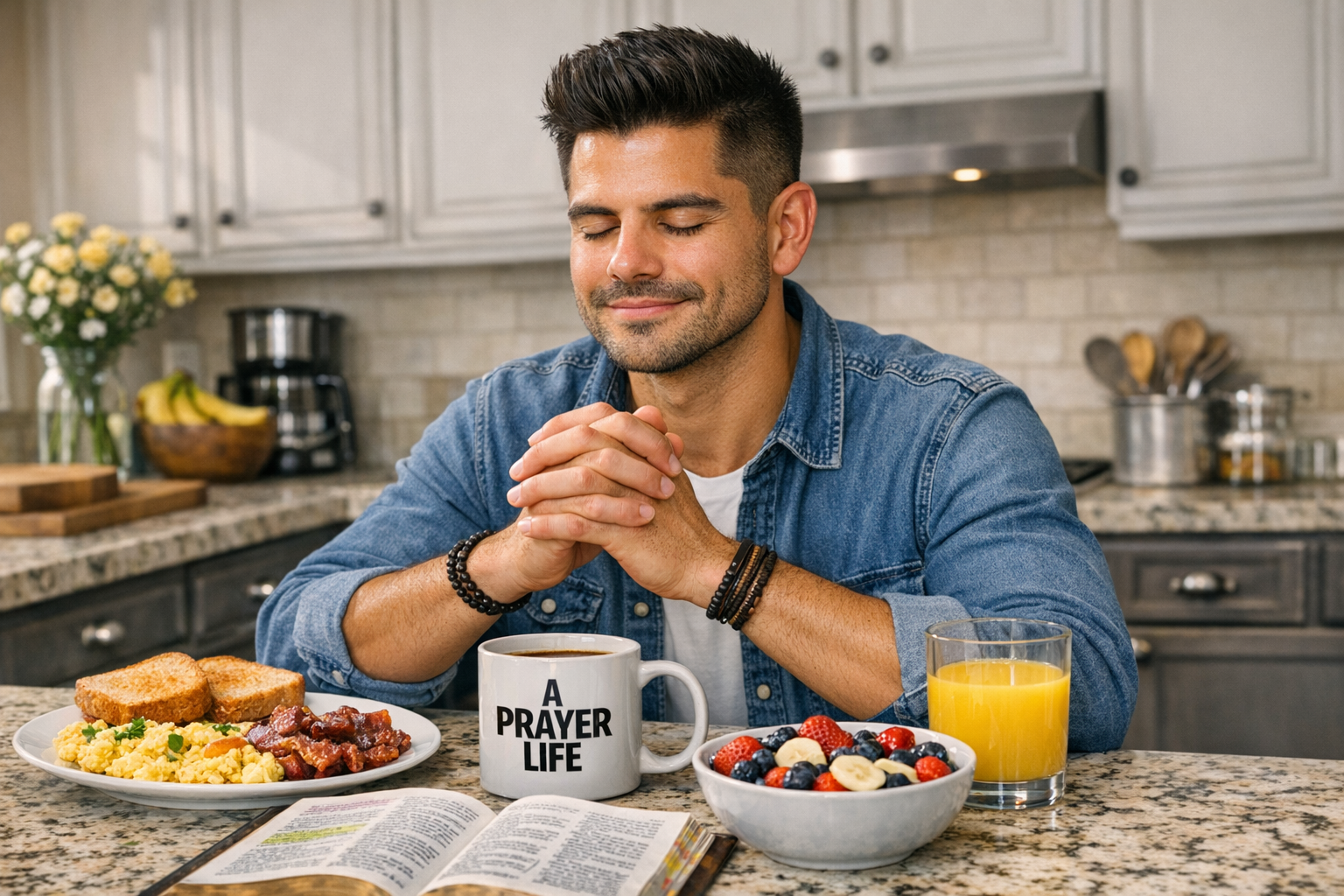
By Ramon Cuevas | A Prayer Life Media
Somewhere between the Sunday school flannel boards and the adult life you’re living right now, something happened to prayer.
It got domesticated.
It got scheduled. It got formatted. It was turned into a five-step process, a morning routine, a devotional checklist, a journal prompt, and a 30-day challenge with a downloadable PDF. It got so packaged, so marketed, so neatly gift-wrapped in religious culture that most people today have an entire catalog of opinions, habits, and experiences around speaking to God
— and almost none of them bear any resemblance to what Devotion actually is.
Ask ten Christians what a prayer life looks like, and you’ll get ten different answers — most of them describing a performance, not a relationship. Most of them were shaped more by church culture, family tradition, and Instagram spirituality than by anything Jesus actually modeled or taught.
And the result?
Millions of people who technically pray but feel nothing. Millions of believers who go through the motions every morning and still feel that God is on the other side of a very thick wall, with their words barely making it through. Millions of people carrying burdens that the petition was designed to lift — but nobody ever told them what prayer actually was, so they’ve been using a hammer where a key was needed and wondering why the door won’t open.
This is a spirit-led life. And today we’re clearing the entire table.
We’re going to talk about what a prayer life actually is. What it absolutely is not. And — maybe most importantly — what well-meaning people, broken systems, and bad theology have made it out to be when they twisted something sacred into something suffocating.
By the time you finish reading this, you won’t just understand prayer differently.
You’ll want it differently.
Let’s start at the foundation, because if you get this wrong, everything else collapses.
A prayer life is not, at its core, a spiritual discipline. It is not a religious practice. It is not a holy obligation that God requires of you in exchange for His attention and favor. Those definitions have infected the church for so long that most people accept them without question — and they quietly destroy the intimacy that speaking to God is actually designed to create.
A prayer life is a relationship.
Specifically, it is the ongoing, living, breathing, daily conversation between you and a God who is not distant, not disinterested, and not waiting for you to earn the right to His ear.
Think about your deepest human relationship. The person you can call at midnight without explaining yourself. The person you can walk into a room with and say absolutely nothing and still feel completely understood. The person who knows the version of you that isn’t performing — the 6 a.m. version, the scared version, the version that doesn’t have it together and isn’t pretending to.
Now multiply that intimacy by infinity and remove every limitation.
That is what God is offering you through spiritual communion.
John 15:15— Jesus looked at His disciples and said something that should have permanently ended the idea of prayer as mere obligation: “No longer do I call you servants… but I have called you friends.” Friends. Not subjects petitioning a king. Not employees filing reports with management. Friends. The word in the original Greek is philos — it means a beloved companion. Someone whose company you seek not because you have to, but because you want to.
Consistent soul-presence is friendship with God.
And like every real friendship, it requires honesty, consistency, vulnerability, and time. Not performance. Not impressive language. Not showing up only when you need something. Time.
Here is a technical truth about prayer that changes everything once it lands:
Prayer is two-directional.
You were never meant to simply transmit. You were meant to receive. The God you are talking to is not a celestial suggestion box. He is not a spiritual wishlist website where you submit your requests and check back in sixty days. He is a Person — the most aware, most present, most communicative Person you will ever encounter — and He responds.
Not always the way you expected. Not always in the timeframe you demanded. But He responds.
Jeremiah 33:3— “Call to Me, and I will answer you, and show you great and mighty things, which you do not know.” That is a two-way transaction. Call. Answer. Show.
A real prayer life includes silence. It includes stillness. It includes the discipline of closing your mouth long enough to hear what the God of the universe might be trying to say into your situation. Most of us have never sat in spiritual stillness long enough to hear anything, because we treat it like a drive-through: place your order, pull forward, gone in three minutes.
That is not a conversation. That is a broadcast.
Sacred companionship is a dialogue. And the other voice in that dialogue has been waiting, patiently, for you to stop talking long enough to listen.
This is the one that dismantles every version of prayer culture built around scheduling and streaks.
A prayer life is not something that happens at 6 a.m. for twenty minutes and then goes dormant for the rest of the day. It is not something that lives in a journal on your nightstand. It is not the opening act of your morning routine, sandwiched between your alarm and your coffee.
Relational alignment is a posture — a constant, underlying orientation of the heart toward God that doesn’t clock in and clock out. It is the difference between visiting someone and living with someone. Between a scheduled appointment and an open-door relationship.
1 Thessalonians 5:17— three of the most radical words in the New Testament: “Pray without ceasing.” Don’t pray without missing a morning. Don’t pray on a schedule. Without ceasing. As in — never fully stop. As in — let prayer become the undercurrent of your entire existence.
That is a lifestyle. That is a prayer life — emphasis on the life.
It happens while you’re stuck in traffic, talking to God about why you’re stuck in traffic. It happens while you’re in the grocery store and something triggers a fear, and instead of letting it spiral, you redirect it into prayer before it becomes an anxiety attack. It happens in the middle of a hard conversation when you take one quiet second to say God give me the right words and mean it.
A prayer life is not an event you attend. It is a world you live in.
Now we get to the dimension of prayer that most comfortable Christianity refuses to address.
Prayer is not passive.
It is not a soft, gentle, peaceful activity that exists only in the category of serenity and stillness. It is also — and this is non-negotiable — a weapon. The primary weapon of spiritual warfare. The mechanism by which heaven’s authority is enforced on earth through the mouths of surrendered believers.
Ephesians 6:18 places prayer at the climax of the entire armor of God passage: “praying always with all prayer and supplication in the Spirit, being watchful to this end with all perseverance and supplication for all the saints.” After the helmet, the shield, the sword — after all of it, prayer.
A real prayer life is a life lived on offense, not defense. It is a life where you don’t just react to what the enemy does — you preemptively move against his plans through intercession, through declaration, through the kind of persistent, faith-charged prayer that Jesus described in Luke 18:1 as praying always and not losing heart.
But — and this is the genius of the Kingdom — it is war waged from a place of rest. Because the battle belongs to the Lord. You don’t pray yourself into exhaustion trying to force God’s hand. You pray from the position of a child who trusts their Father, who knows that the outcome has already been settled, and who is simply enforcing, through prayer, what heaven has already decided.
That combination — holy urgency and deep rest — is what a prayer life feels like when it’s real.
This needs to be said so clearly that it echoes.
God is not impressed by your articulation. He does not grade your prayers on vocabulary, fluency, theological precision, or emotional intensity. He is not moved by the quality of your delivery. He is moved by the sincerity of your heart.
Matthew 6:7 — Jesus warned His disciples: “Do not use vain repetitions as the heathen do. For they think that they will be heard for their many words.”
One of the most spiritually crippling things that happens to believers — especially people who grew up in expressive church cultures where prayer was a public art form — is the belief that effective prayer requires a certain sound. A certain cadence. A certain level of emotional performance that signals to God and the people around you that you are really, truly engaged.
And so people who can’t find that sound stay silent. People who feel they don’t pray “well enough” don’t pray at all. People who feel awkward and inarticulate in the presence of God — which is every single human being who has ever been honest about it — decide that prayer must not be for them.
It doesn’t require a performance. It requires presence.
Here is a theology that has done incalculable damage to the prayer lives of millions of people:
If I pray right, believe right, and say the right things in the right order, God is obligated to give me what I ask for.
That is not prayer. That is superstition dressed in scripture.
A prayer life is not a spiritual system you master in order to extract the outcomes you want. God is not a cosmic vending machine. Prayer is not a combination code. And the prosperity-adjacent, name-it-claim-it framework that has infected so much of modern Christian culture has produced a generation of believers who prayed confidently for something specific, didn’t receive it the way they expected, and walked away from prayer — and sometimes from God — convinced that the system failed them.
The system they were sold was never real.
Real prayer is not about bending God’s will to yours. It is about aligning your will to His. It is the ultimate act of surrender disguised as a conversation. When Jesus taught us to pray “Your will be done on earth as it is in heaven” ( Matthew 6:10), He was establishing the entire orientation of a praying life — one that trusts God’s wisdom more than it trusts its own preferences.
That’s not a weakness. That is the highest form of faith.
If the only time you pray is when something goes wrong, you do not have a prayer life.
You have a prayer emergency service. And emergency services, by definition, show up after the damage is already done.
Here is what that pattern actually costs you — practically, measurably, spiritually. Every season of drought you endure alone, before you finally get desperate enough to pray, is a season you spent without the resource that could have sustained you through it. Every decision made in your own strength, before you eventually hit the wall and surrender it to God, carries the weight of consequences that prayer at the beginning might have redirected.
A prayer life doesn’t wait for the crisis. A prayer life is the reason fewer crises become catastrophes.
Psalm 46:1 calls God “a very present help in trouble.” Present. In trouble. He is not startled by your emergency. But He was also present before it, and a prayer life is what keeps the channel open before the storm, not just during it.
This might be the most practically important thing in this entire article.
A prayer life is not measured by how it feels.
Some of the most powerful prayers ever prayed felt completely dry when they were spoken. Some of the most transformative seasons of intimacy with God happen in the middle of spiritual deserts where worship feels forced, scripture feels flat, and prayer feels like speaking into an empty room.
Those seasons are not failures. They are invitations.
Hebrews 11:1 — “Faith is the substance of things hoped for, the evidence of things not seen.” If your prayer life is dependent on emotional confirmation at every turn, you don’t have a prayer life driven by faith. You have a prayer life driven by feeling — and feeling is one of the most unreliable navigational instruments in the known universe.
You show up to pray on the days it feels electric, and the days it feels like nothing. You show up when you feel close to God and when you feel like He moved across town and left no forwarding address. Because a prayer life is not a feeling you chase. It is a commitment you honor.
And on the other side of the dry season, every single time, is a depth with God that the easy seasons never produce.
In too many faith communities, prayer has become a performance of obligation. Something you do to prove you’re serious. A metric by which spiritual maturity is measured and spiritual worth is assigned. An hour a day makes you devoted. Fifteen minutes make you mediocre. Missing a morning makes you backslidden.
That framework doesn’t produce intimacy with God. It produces anxiety about God. It produces the kind of believer who has a complicated, shame-laden relationship with prayer — who dreads it more than they desire it because every session is loaded with the weight of not doing it enough, not doing it right, not being enough.
That is religion. That is not a relationship.
The God of the Bible is not keeping a prayer log. He is keeping a seat warm for you in the secret place, and the invitation is always open, and the door is always unlocked, and there is no version of you too far gone to walk through it.
Somewhere along the way, the church created a two-tier spiritual economy where certain people are “gifted in prayer,” and the rest of us are meant to be grateful that they show up to intercede on our behalf.
And it produced something genuinely damaging — a generation of believers who outsourced their prayer lives to the spiritually eloquent, to the intercessors, to the people in the front row who weep during worship and seem to have some kind of direct line that the rest of us can’t access.
Prayer is not a talent. It is a birthright.
The moment you received Christ, you received access. Full, complete, unmediated access to the throne of God — not a waiting list, not a secondary entrance, not a lesser version of what the “gifted” people get. The same Holy Spirit that groans in the most powerful intercessor you’ve ever witnessed is the same Holy Spirit living in you, right now, ready to help you pray in ways your words can’t even fully express ( Romans 8:26).
You are not waiting to become someone who can pray powerfully. You already are.
Here’s the subtle lie that kills more mature believers than almost anything else:
I’ve been doing this long enough. I know enough scripture. I’ve had enough experiences with God. I don’t need the basics anymore.
Prayer is not the starting point of the Christian life that you eventually move beyond. It is the constant. The non-negotiable. The thing that every spiritual giant in the history of faith kept returning to, kept deepening, kept refusing to graduate from.
David — a man after God’s own heart, a warrior, a king, a songwriter, a man who had seen God move in ways most of us will only read about — wrote Psalm 63:1: “O God, You are my God; early will I seek You; my soul thirsts for You; my flesh longs for You in a dry and thirsty land where there is no water.”
That is not a beginner. That is a man decades into his relationship with God, still desperate for more of Him.
The more you know God, the more you want Him. The deeper your prayer life goes, the more you realize you haven’t scratched the surface. There is no graduation. There is only going deeper.
Now you know what it is. You know what it isn’t. You know what it was never supposed to be.
So what do you do with that?
You build.
Not perfectly. Not all at once. Not with a complete theological framework downloaded into your brain overnight. You build the way every real thing gets built — one honest conversation at a time. One day of showing up at a time. One prayer that feels like nothing but represents everything — a choice to believe that God is there, that He hears, and that you are worth showing up for.
This blog exists to walk every step of that build with you. We will talk about prayer in the dark, prayer in the fire, prayer in the desert, and prayer in the breakthrough. We will talk about it honestly, specifically, practically, and without a single ounce of the religious fluff that has kept you at arm’s length from the most powerful practice available to you as a human being made in the image of God.
Because this is not a blog about religion.
This is a blog about relationships.
This is not a blog about performance.
This is a blog about presence.
This is A Prayer Life — raw, real, unfiltered, and built for the version of you that is finally done pretending that where you are is where you’re supposed to stay.
You came here with some version of this question living somewhere underneath everything else:
Is there more than this?
More than the routine that feels hollow. More than the faith that looks good from the outside but feels thin when you’re alone with it. More than the prayers that never seem to land, the silence that feels like rejection, the distance that makes you wonder if the whole thing is even real.
Yes. There is so much more.
Ephesians 3:20 — “Now to Him who is able to do exceedingly abundantly above all that we ask or think, according to the power that works in us.” Above all, you ask. Above all, think. Above every ceiling you’ve placed on what God can do in your life, your circumstances, your relationships, your future.
That power works in you. Not around you. Not above you somewhere out of reach.
In you.
But it flows through prayer. It is activated by prayer. It is sustained by prayer.
A prayer life is not a religious accessory. It is not a spiritual hobby for people who have extra time. It is the very heartbeat of everything God intended for your life — and the moment you treat it that way, everything changes.
Not some things. Everything .
Start today. Not with a plan. Not with a schedule. Not with a commitment you’ll feel guilty about breaking by Thursday. Start with one honest sentence to a God who has been leaning toward you since before you knew His name.
Start there.
That’s how a heartbeat begins.
Receive “21 Savage Prayers” FREE — a no-nonsense, powerful prayer guide for believers who are done with surface-level. Real prayers. Real faith. No fluff. Join us at aprayerlife.com.
Ramon Cuevas is the founder of A Prayer Life — a bold Christian lifestyle platform for believers ready to go deeper than Sunday morning.